Mewgenics

Mewgenics
Gameplay duration: 30.7 hours (still in progress)
I don't think Mewgenics can be defined as the direct successor to The Binding of Isaac. It certainly reincarnates its art style, irreverence, and that pinch of the macabre that never hurts, plagiarizing its chaotic soul; however, it adds new mechanics and challenge levels that, ultimately, make it a fresh and highly addictive game.
Impressions
Unlike many other titles, Mewgenics didn't have a media epic made of leaks (not just rumors, looking at you Resident Evil Requiem), teasers, extreme hype, or other annoying marketing stunts. What resonated most—and perhaps rightly so—were the names of its creators: Edmund McMillen, father of the already famous The Binding of Isaac, and his talented co-developer Tyler Glaiel.
I was never a hardcore Isaac player: I never had the patience to shoulder the blame for a lack of skill that led to losing individual runs too prematurely; if nothing else, the fact that it was a pure roguelike always made this shortcoming quite evident.
However, with Mewgenics, the approach was decidedly different. The inclusion of turn-based combat gently introduced me to a mechanic I'm much more accustomed to—one I was genuinely surprised to find in a game conceived by these developers. I arrived at day one (February 10, 2026) with zero information in hand and bought it blind. And I don't regret it, especially considering the critical acclaim that placed it around a 90 on Metacritic.
The initial impact makes no attempt to hide the creative minds behind this title: the menus, the graphic style, the character design, and the irony pull us straight into Isaac's artistic universe, now in a modern, isometric key. The "macabre" is punctual—never gratuitous—here too, and from the very first minutes, right after being introduced to the basic mechanics, that familiar itch for "grinding" is already teased.
Equally clear, however, is the warning implicitly suggested by the game mechanics themselves: while Isaac was perfectly playable in the background while watching a YouTube video, a Twitch stream, or sitting through a boring work call, this kind of multitasking isn't nearly as easy in Mewgenics, especially in the early stages. This isn't just due to the complexity of the combat (which is anything but trivial), but rather the tactics and strategy required before even embarking on a run.
Attention span aside, Mewgenics left a super positive impression on me. It's visually pleasing, features a highly respectable soundtrack (catchy, entirely cat-themed—in case the title didn't give it away—and never annoying), and boasts a balanced challenge level that punishes even the slightest distraction while rewarding, in its own way, the smartest strategic choices.
Little fun fact: during one of my explorations, I found a piece of gear called the "emo wig." It gives -1 to all stats for the cat wearing it. It made me laugh out loud.
Gameplay
Mewgenics is a tactical turn-based roguelike RPG with some management elements; some even throw in a brief cat-themed life-sim parenthesis.
I don't entirely agree with that second definition, but I get the reasoning: we have a base to expand, upgrade, and where we must obviously care for the cats we acquire during the game. We start with a modestly sized house and eventually expand it, upgrading its features to positively influence the felines living there and prepare for our expeditions. There's also a day-night cycle during which a specific amount of food is consumed (depending on the size of our colony), and several things can happen:
- Nothing
- Cats mate and give birth to kittens
- Cats fight and potentially get injured or sick
- Older cats cross the rainbow bridge
The Base
This cycle essentially ensures our feline colony is always well-populated. Our goal is to provide them with the best possible domestic environment to stimulate breeding and avoid accidents.
We actually have another way to fill our base with cats: at the start of each day, a stray will be waiting outside our door, hoping to be taken in. As we upgrade the base, we improve its appeal and attract cats with increasingly better stats.
Every cat, in fact, has stats pulled straight from the RPG basket, such as strength, health, max mana, movement capacity, ranged attack, and mana regeneration. Having good starting stats is crucial to avoiding a premature defeat during adventures and, in most cases, will rely solely on the genetic combination of the cats that bred a specific kitten.
The loop thus begins to take shape:
- Gather resources
- Upgrade the base
- Attract progressively better strays
- Breed increasingly capable kittens
The Adventure
At the start of each day, we can select four cats as the designated party for a new adventure.
Forget about one thing right away: each party can only be used for a single run. Once it's over, our group will either:
- Completely disband following a crushing defeat.
- Return home victorious, bring back the loot (food and money), and become "retired."
In either case, that specific group will never be playable again.
Once the adventure cats are selected, we can assign them a class. To be precise—since we're talking about cats—it's a colored collar that grants a specific skill bonus for that class type. Equipping a "tank" collar on a cat, for example, increases its max health; assigning a mage collar boosts its max mana, and so on.
After the assignment phase, we can dive into our inventory to give each cat some gear, whether it's a makeshift piece of scrap metal used as a helmet or an incredibly sophisticated, high-tech laser weapon.
During the adventure, we also get a taste of the roguelike mechanics. We have a map to explore made up of linear paths that eventually branch out, forcing us to choose which way to go. Each path features random encounters that require us to pass skill checks, rewarding us for success or punishing us for failure. There are also specific nodes where we can spend our hard-earned cash to buy upgrades or healing items from a merchant. Our journey naturally alternates between encounters, enemy mobs, and boss fights.
Up to this point, it's about choosing the path that best suits our resource-gathering needs. However, the most strategic choice probably lies in the map sections where we must decide whether to take the hard or easy route. The former obviously has a higher difficulty spike but yields better rewards; the latter is more linear and safer, but provides fewer resources and limits our cats' growth potential.
Like any self-respecting RPG, each cat gains experience at the end of every battle. This allows them to level up, learn new skills, and improve their stats.
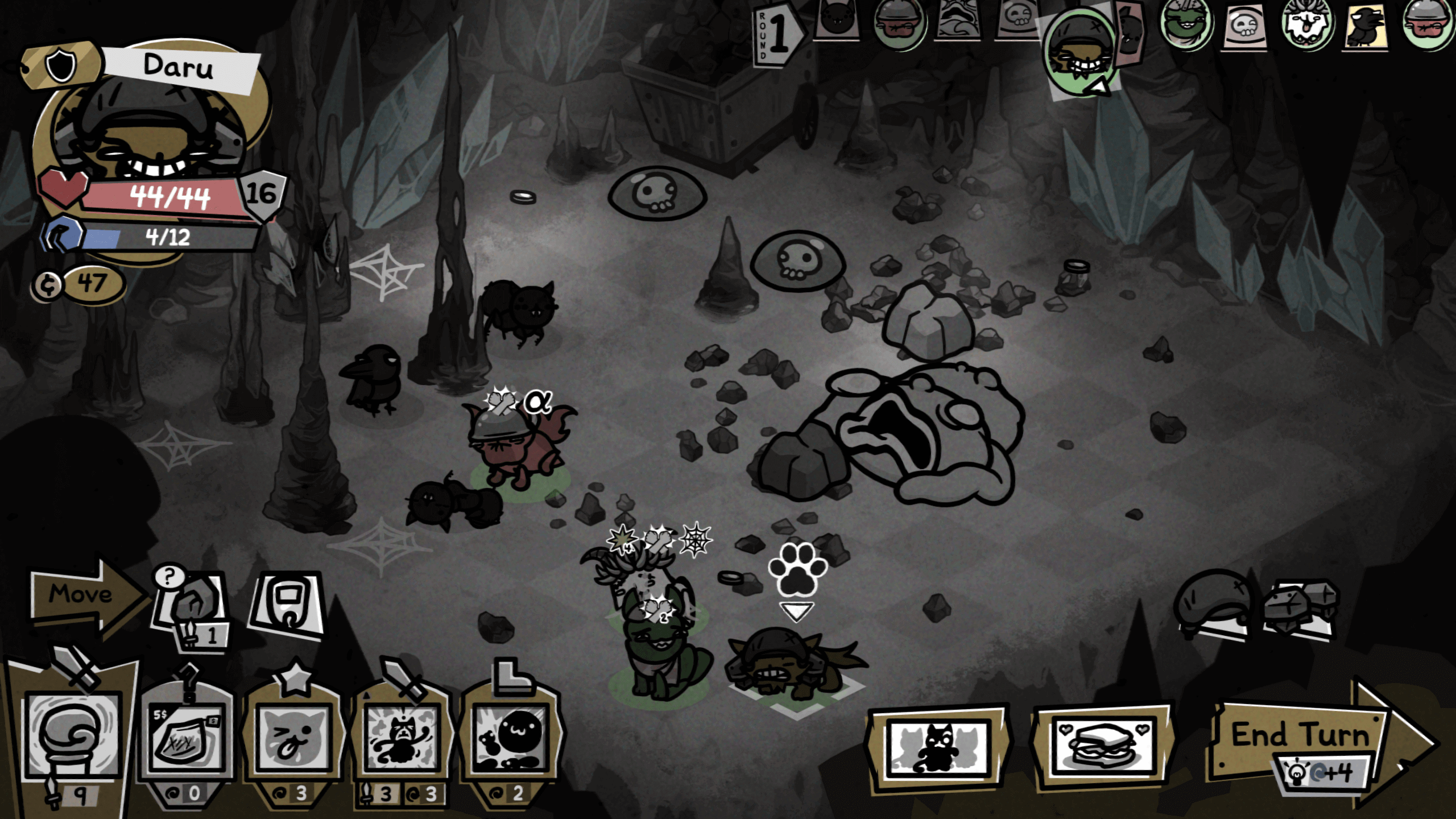
Combat is turn-based, and each turn consists of a basic movement action, a basic attack, and the use of spells/abilities as long as we have the required mana. That's the core rule, but through passive skills or gear, we can gain extra movement or a chance to reuse our basic attack.
Every time we clear a map (or zone), we get to choose whether to return to base or push forward. In the early stages, this choice is somewhat forced because we need to unlock new zones as we explore. Defeating a map's boss almost always notifies us that we've unlocked a new area to explore on our next adventure—obviously with a different party that might not inherently possess the traits needed to survive the new hazards. It becomes necessary, almost inevitable, to study the different environments and bosses to prepare a sufficiently well-rounded party to tackle whatever dangers lie ahead.
Return to Base
Once back at the base, assuming the expedition was successful, we receive food and money as primary resources and get to keep all the gear we found (though some pieces might break or gain a "used" status).
In this phase, we must manage our resources and potentially invest in upgrades or items that will be useful for the next run. Occasionally, by meeting the right conditions, we'll receive a specific "quest item." We'll be asked to equip it during our next adventure and reach a specific zone to complete the quest.
We also get to manage our colony during this downtime. As we progress through the story, we'll meet members of the neighborhood—peculiar characters who make requests, asking us to send them cats with specific traits. With every milestone reached in their questlines, we unlock bonuses and perks.
Story
Following the opening cinematic, we learn that a certain Dr. Beanies, a scientist with a highly questionable moral compass, wakes us up in his lab and immediately indoctrinates us on how cats can be made better through science.
At the time of writing this article, I don't think I've progressed enough to outline a complete storyline, though I'm fairly certain this game isn't heavily reliant on plot or narrative elements.
The impression I get is that Dr. Beanies wakes us up in the body of an unlikely assistant/crazy cat lady. This perfectly aligns with the feline hoarding dynamic and the scientist's explicit demand to gather and care for as many cats as possible in the name of progress.
The Flip Side: Interface and Unforgiving RNG
Despite the strong addiction the title manages to generate, Mewgenics suffers from several non-negligible flaws that can severely impact the User Experience. First and foremost, the interface proves problematic during combat phases. The color palette—deliberately kept dark and gritty as a nod to the development team's signature aesthetic—often ends up camouflaging smaller enemies or summoned allies among the environmental debris. Exacerbating this issue is a decidedly stiff camera system. The fixed perspective makes it unnecessarily frustrating to see, or even click on, units unfortunately positioned behind corners or particularly bulky environmental objects. An even more glaring flaw for a strategy game is the severe lack of an "Undo" button or a movement confirmation prompt: a single unintentional move or a trivial misclick can spell doom for an entire run, a problem compounded by the hassle of manually counting grid squares to estimate attack range since the game lacks intuitive predictive targeting grids.
On the balancing front, the application of randomness (RNG) occasionally borders on unjustified sadism, stripping the player of any agency. The community has widely condemned the existence of entirely unavoidable events and debuffs: running into a heatwave that completely prevents healing, or sudden sandstorms, often means watching your party get decimated without having the tactical tools to survive. Adding to this feeling of helplessness is the so-called "False Agency" stemming from certain narrative scripts. In specific events (such as the extreme case of the "floating fetus"), the game creates the illusion of choice by presenting multiple dialogue options that, ultimately, all force the player toward the exact same inevitable negative outcome. It's a punitive level design that sometimes crosses the line from a satisfying challenge into pure frustration.